
How Do Plush Toys Help With Child Development?
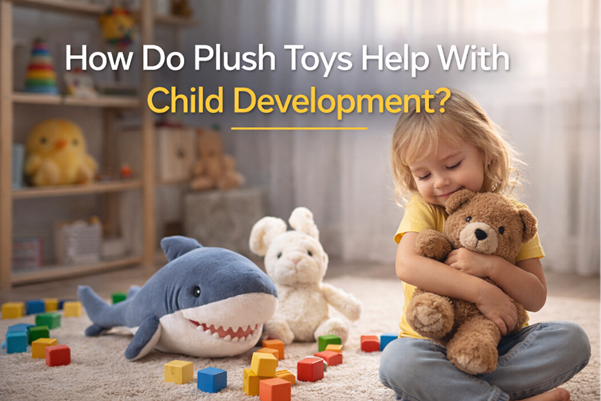
Children learn and develop based on their daily life experiences, including the toys they play with.
That said, most parents are often attracted to educational games, puzzles, and learning tools, but often neglect the developmental importance of plush toys. These toys tend to become the constant companion of a child at some point during playtime, when going to sleep, or when there is a need to comfort the child.
Meanwhile, parents are usually left wondering whether plush toys can contribute to learning, or if they are just playthings that give children a sense of comfort.
Even though they seem basic at first glance, plush toys can contribute to emotional, social, and cognitive development. Cuddling, storytelling, and imaginative play help children develop key life skills in a natural and interactive manner.
This article discusses the way in which plush toys aid in child development across various dimensions and why they are worth keeping as a means of learning and growth.
1. Build Emotional Security
A Shark Plush or any other soft stuffed friend is one of the first things that a child will be emotionally connected to. Due to the softness and the comfort plush toys provide, children tend to use them in times of uncertainty, exhaustion, or stress.
Young children are often faced with something that seems overwhelming, like going to a daycare, sleeping alone, or encountering new people. A known plush toy is reassuring at these times. The playful nature of the touch and the homelike nature establish a feeling of security.
With time, this attachment enables children to control their emotions in a better way. They learn to relax by hugging or holding onto their favorite toy. Plush toys are, therefore, transitional comfort items that guide children through new experiences with more confidence.
2. Promote Imaginative Play
During early childhood, imagination is central to development. During imaginative play, children test hypotheses and emotions along with problem-solving scenarios. Plush toys have just become characters in these imaginative situations. A child can make a stuffed animal his hero, his friend, or his amiable guide during fantasy journeys.
Such storytelling exercises encourage imagination and make children think out of the box. Moreover, imaginative play enables children to experience real-life situations safely.
As an illustration, a child can pretend that his plush toy is visiting the doctor or learning to swim. As they play these scenarios, children become conversant with situations they may encounter in the future.
3. Improve Social and Communication Skills
Children may also communicate through chatting with their toys. This might sound easy, but in fact, it is very important in language development. Talking to plush toys, children train to construct sentences, share their emotions, and communicate their ideas.
These discussions aid in developing vocabulary, besides enhancing verbal expression confidence. Moreover, plush toys can be used as role-playing partners. Children can also switch speaking as different characters or act like they are talking to toys.
As a result, these interactions help children learn social behaviors such as listening, responding, and sharing. Role-playing also helps children to see and observe the patterns of communication they witness in adults. As an example, they might imitate the behavior of a parent comforting their plush toy.
4. Build Empathy and Nurture Behavior
Empathy is one of the best things that children learn during play. Plush toys can even promote nurturing behavior since children treat them as living beings.
As an example, children can stuff their plush toy into bed, give it pretend food, or soothe it when it seems sad. Such little gestures of love make children know how to take care of others.
The process of nurturing play makes children start to see emotions and react with compassion. They get to know that other people might need to be comforted, attended to, or assisted.
Besides, this form of play enhances emotional awareness. Children learn to feel happy, fearful, or sad when they show care for their toys. Through such early experiences, the person develops greater emotional intelligence and more empathetic interpersonal relationships over time.
5. Improve Sensory Development
Young children learn about the world based on their senses, especially touch. Plush toys that are soft offer highly sought-after tactile experiences that contribute to sensory development. Smooth fabric, soft stuffing, and flexible forms are some examples of textures that will help a child develop their sense of touch.
When children hold, squeeze, and cuddle plush toys, they gain a stronger idea of various textures and physical sensations. Tactile play is also beneficial in the development of fine motor skills. Holding, touching, and playing with plush toys involve the use of hands and fingers.
6. Favor Daily and Autonomous Comfort
Children may sometimes find it difficult to get through their daily routine, especially during transitions such as bedtime or during travel. During such times, plush toys usually become trusted friends. As an example, a child can bring his or her favorite plush toy to sleep.
Having something familiar establishes a pattern that is expected, hence indicating a state of comfort and relaxation. Also, plush toys may make children feel safe when being in new settings, e.g., when visiting family members or attending preschool. A toy that is trusted helps to ease anxiety and makes the transitions easier.
Final Thoughts
Plush toys might seem very basic, but their influence on child development is significant and extensive. Whether it is comforting their emotions or entering fantasy, these plush friends assist kids in experimenting with their feelings, communicating with others, and learning to show empathy.
Moreover, plush toys assist in sensorial learning, creativity, and daily routine, which encourages emotional security. Since they provide comfort through interactive play, they can be useful tools for learning as well as emotional development.
Well-selected plush toys may be significant in the development of a child by enhancing creativity, fostering behavior, and the feeling of security that promotes healthy growth.